Sending a POST Request to the HTTPS Test Server
Use Unified Endpoint, Beam's HTTP entry point, and Soracom's HTTPS test server to verify how Beam forwards POST requests.
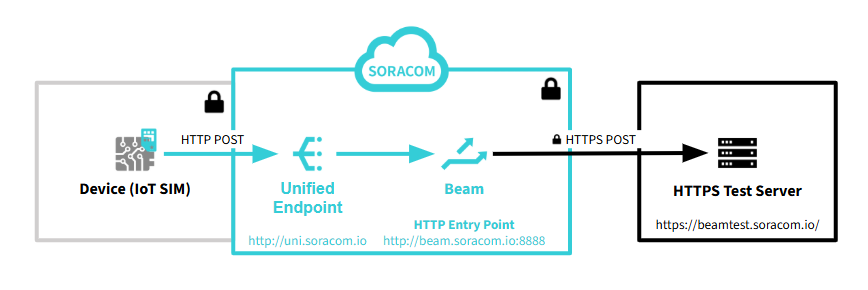
No special setup is required to use Unified Endpoint and the HTTPS test server. In this tutorial, you will add an HTTP entry point configuration and send a POST request from your device.
The device sends POST requests to Unified Endpoint (http://uni.soracom.io). The device does not need to know the Beam HTTP entry point URL or the HTTPS test server URL.
Configuring HTTP Entry Point
Add an HTTP entry point configuration to your SIM group and assign your IoT SIM to the group.
Beam settings are configured at the group level. For more information about groups, see Groups.
-
In the SIM group settings screen, choose a group, then select Soracom Beam.
For detailed instructions on how to open the SIM Group settings screen, see Group Settings.
-
Click + Add Configuration and select HTTP entry point.
The Soracom Beam - HTTP configuration screen appears.
-
Configure the following settings:
Item Value Configuration name Enter any name. Example: http over sslEntry point > Path Enter /.Destination > Protocol Select HTTPS.Destination > Host name Enter beamtest.soracom.io.Destination > Port number Leave blank. Destination > Path Enter /.Client Certificate Leave off. Header manipulations > IMSI Header Turn on. Header manipulations > SIM ID Header Turn on. For more information about HTTP entry point settings, see HTTP Entry Point.
-
Click Save.
-
Assign your IoT SIM to the group.
Beam configuration is now complete.
Sending a POST Request from Your Device
POST requests sent to Unified Endpoint are forwarded through Unified Endpoint and Beam to the HTTPS test server. The test server processes the HTTP body (payload) and returns a response.
Beam charges are incurred per request. A free tier is available. For more information, see Soracom Beam Pricing.
-
From a device using an IoT SIM configured with the HTTP entry point, send a POST request to Unified Endpoint (
http://uni.soracom.io).POST request example:
curl http://uni.soracom.io -d 'Hello from Soracom SIM'Response:
{
  "message": "Hello from Soracom SIM",
  "headers": {
    "X-Soracom-Imsi": "295050012345678",
    "X-Soracom-Sim-Id": "8942310000012345678"
  },
  "log": {
    "preSharedKey": "",
    "stringToSign": "",
    "calculatedSignature": "",
    "providedSignature": "",
    "trails": null
  }
}
If the request does not work as expected, check the error logs. For more information, see Soracom Beam Errors.
You can also send POST requests directly to the HTTP entry point (
http://beam.soracom.io:8888) instead of Unified Endpoint, with the same result.
Unified Endpoint Benefits
Data sent to Unified Endpoint can also be forwarded to Harvest Data, Funnel, and Funk. This allows you to change destinations from the User Console without modifying your device configuration. For POST requests, using Unified Endpoint is recommended.
Understanding the Response
The response is generated by the HTTPS test server. The message field contains the request body. The headers object shows supported Soracom headers that were added by Beam based on the enabled header options in the Header manipulations section of your group configuration. In this example, IMSI and SIM ID headers are enabled. The HTTPS test server returns only predefined Soracom headers and does not include custom headers configured in Beam.
Disabling Beam Configuration
Beam charges are incurred per request. If you are not using Beam, disable the entry point configuration or remove the IoT SIM from the group.
- To stop forwarding requests via Beam, open your SIM group settings and disable or delete the HTTP entry point configuration.
- To remove an IoT SIM from a group, see Removing a Device from a Group.